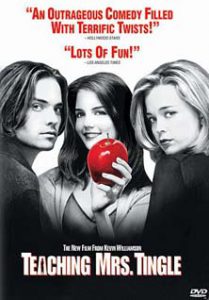
- By John Hansen
- 04 Sep, 2025
- Movies
Coughlan goes to head of the class in ‘Teaching Mrs. Tingle’ (1999)
Because of its premise of high school students going toe-to-toe with an evil teacher, the star-making turn by Marisa Coughlan (who goes toe-to-toe with veteran Helen Mirren) and the best top-to-bottom soundtrack from the best year ever of teen movies (and, no, I didn’t forget about “Varsity Blues”), there’s little chance of me bailing on “Teaching Mrs. Tingle” (1999).
Williamson takes the helm
Kevin Williamson’s first directorial effort was known as “Killing Mrs. Tingle” almost up until the release date. (Surprisingly, it remains the only movie he has directed, though he’s slated to helm next year’s “Scream 7.”) The title was changed due to Columbine and it’s also more accurate because no one is killed. Being a “Dawson’s Creek” and Katie Holmes fan, and very much a non-fan of high school (from which I graduated in 1996), there was little chance of me not liking it.
That said (and granted, there’s no chance of this, for many reasons), “Teaching Mrs. Tingle” would benefit from a remake. Tonally, heading into the moment when the heroic trio (Holmes’ Leigh Ann Watson, Coughlan’s Jo Lynn Jordan and Barry Watson’s Luke Churner) graze Mrs. Tingle (Mirren) with an arrow, there’s a chance they will indeed kill her and this will perhaps be something like “Weekend at Bernie’s.”
“Teaching Mrs. Tingle” (1999)
Director: Kevin Williamson
Writer: Kevin Williamson
Stars: Helen Mirren, Marisa Coughlan, Katie Holmes
When Tingle turns out to be merely unconscious, Jo Lynn suggests they “finish her,” and it’s the only time I chuckled out loud; it’s now clear it’s not that type of movie. All danger shall be “movie danger”; it’s a dark comedy, but not “Pulp Fiction” dark, or even “Go” dark. That said, the tonal schizophrenia continues to reign (not always in a bad way; I’ll break out the apologetics in a bit) and I think a remake could add depth to the core questions of why a teacher would use her position as a power trip and why a public school is powerless to fire her.
“Tingle” is Williamson’s most personal project, a reward from Miramax for the success of “Scream,” “I Know What You Did Last Summer” and “The Faculty.” Some label it as weak due to being directed by the writer, but that’s not the primary issue; his direction is basic but harmless.
The issues are that it’s experimental and risky, and Williamson still wants to riff, but he doesn’t have forebearers to riff on. The best he can do is (purposely, I think) use a mishmash of familiar names. Holmes’ character’s last name is Watson, same as actor Barry’s. Coughlan’s character’s last name is Jordan, and Barry Watson is playing Jordan Catalano Lite. Michael McKean’s character is Principal Potter, the same last name as Holmes’ “Dawson’s Creek” character, whose first name is Joey, similar to Coughlan’s Jo Lynn.
A pre-‘Bad Teacher’ bad teacher
Compared to movies about good teachers, there are fewer about bad ones. (The straight-up comedic “Bad Teacher” would arrive in 2011.) Williamson had previously riffed on existing tropes, but here he’s trying to break ground, and his shovel needs sharpening – particularly when we get to revelations (or pseudo-revelations) about what makes Tingle tick.
Once the three teens have Tingle tied to her bed, the narrative crux is that Tingle will call upon her manipulation skills (classed up because she references classic literature) to break up the friendships. Jo Lynn is all about Luke (she kisses him without consent to see what it’s like, something that no one blinked at in 1999). Luke harbors feelings for Leigh Ann, who is all about being serious and getting into college.
Despite Williamson not having a postmodern entry point, there’s nonetheless good build-up before Tingle (and the narrative) get tied down. The three teens and their love triangle are well drawn. Leigh Ann needs an “A” from Tingle to earn a college scholarship and get out of Grandsboro (the typical “horrible” small town that looks like a Hollywood backlot). But Tingle won’t grant it because she’s envious; she never got out of the town herself. Leigh Ann clearly earns the “A” with a hilariously impressive year-long diary of an accused Salem witch, but Tingle gives her a “C.”
Luke is a mirror of his drunken father, as Tingle reminds him at every opportunity, but notably we never see him drunk (although he does enjoy beer and wine). Jo Lynn is a great actress – she does an amazing Marilyn Monroe skit for her project, an impromptu “Exorcist” re-enacting simply because she’s bored, and impressions of Tingle’s voice that would make Ferris Bueller tip his cap. Tingle regularly calls her a horrible actress.
As noted, this is a star-making film debut by Coughlan, who acts out many of these moments in front of Mirren. She’s a discovery by Williamson on par with Holmes in “Dawson’s Creek,” but of course the more accurate phrase is “would-be star-making turn.” Coughlan soon landed in Williamson’s “Wasteland” (1999, ABC), which is lost to history, and later “Side Order of Life” (2007, Lifetime), which I loved and which is also totally lost. Though not wanting for work, Coughlan is best known as a member of the “Super Troopers” troupe, and that’s a shame.
Flawed yet fondly remembered
While Mirren is good, the downside is that Tingle is so thoroughly manipulative and dishonest that it always seems like the explanation for her “Mrs.” title can’t be as simple as her husband leaving her for another woman. She tells that story to Luke to help drive a rift among the three friends, but I suppose it is, conveniently, a true story in this case.
The title and Mirren’s presence make people misread Williamson’s focus (which is his own fault, since he directs). The movie is actually about Leigh Ann, Jo Lynn and Luke, like a John Hughes film would be. This is indicated by the soundtrack of lyrically depressive (though sometimes musically upbeat) teen-angst pop-rock.
The fact that they have to overcome an evil adult as an obstacle toward their adult lives is awful, but Williamson has no commentary on why this happens, unless “inertia” is the answer. (SPOILERS FOLLOW.) At the end, the principal says: “Mrs. Tingle, I have waited 20 years to tell you this. You’re fired.” Because Tingle has shot an arrow at Leigh Ann (and, out of character, she admits to doing so with the intent to kill her), she is now fire-able. The film doesn’t address why that wasn’t possible in the previous 20 years. (END OF SPOILERS.)
In 1999, I don’t think knowledge of teachers’ union’s power was mainstream enough that it could go without saying. And even so, that only applies in some states. In other states, you need no reason to fire a teacher. The movie is set in California, a state of entrenched bureaucracy, but there’s no reason it need be.
When Stretch Princess, the Moffatts or Tara McLean (covering Janis Ian’s “At Seventeen”) come to the front of the mix, I think of the cruel poignancy of being a teenager. Mirren’s presence buries the teens, which is fitting but frustrating. Williamson, 34 at the time, made “Teaching Mrs. Tingle” when he could still tap into his youthful angst but when he also was unpolished in directing and writing non-postmodern scripts. It’s the most imperfect of his initial burst of projects, but I can’t deny I recall it fondly.
)
Leave a Comment