- By John Hansen
- 04 Nov, 2025
- Books
‘Echoes of Guilt’ is like a Lifetime movie without an editor
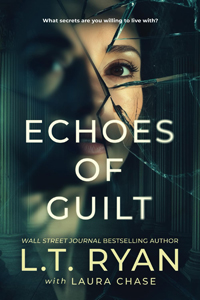
“Echoes of Guilt” (February, paperback and digital), by L.T. Ryan with Laura Chase, is one of hundreds or maybe thousands of modern books that serves as a case study for the question “Do we need copy editors?” While digital-first and on-demand publishing have ended old-fashioned gatekeeping, publishing still has expenses. And as with newspapers, magazines and websites, smaller book publishers have cut out the expense of thorough, dedicated copy editing.
Whether that hampers the reading experience or not is up to each reader to decide. I am biased, having worked as a newspaper copy editor when those jobs existed. But it’s hard to deny that this thriller about 20-something Savannah lawyer Claire possibly being stalked by her convicted serial-killer client desperately needed line editing and content editing.
For instance, the client is named Anthony Bates, and the family plural shows up as Bates or Bates’ but never the correct Bateses. Quote marks are not in the proper curved style at any point, and they are often out of place.

“Echoes of Guilt” (2025)
Authors: L.T. Ryan with Laura Chase
Genres: Mystery, thriller
Series: Savannah Shadows Psychological Thrillers
Setting: Savannah, Ga., present day
Note to readers: The Book Club Book Report series features books I’m reading for my book club, Brilliant Bookworms.
Now I should admit that I got used to it, by pretending I was reading a rough draft. There’s certainly something here; Ryan has written dozens of books, and if she’s a hack, she’s a skilled hack. I wanted to find out the answers to the mysteries. Is Bates innocent, and wrongly convicted? Who is threatening Claire? Who is the actual serial killer, and why?
Content editing could’ve turned “Echoes of Guilt” into a quite good novel. Its themes are valid, including the flaws in the court system, lazy and corrupt police work, anxiety and stress, and buried guilt over a past event.
Guilty of not being realistic
Broadly, all these things can happen in reality, but “Echoes” never snugly fits with reality. People are wrongly convicted in the real world, of course, but in this case there’s no evidence against Bates other than his confession, which was clearly done without his Miranda rights being read. Someone can be anxious, of course, but why is Claire anxious that Bates will attack her if he goes free? That’s oddly specific, like she knows she is a character in a plot (and a Lifetime movie plot, at that).
For everything to happen in “Echoes,” it requires across-the-board incompetent lawyers, judges, jurors and police detectives, along with an incredibly lucky culprit. Although there are motivational reasons for some of these behaviors, Ryan mostly doesn’t dig into them; it’s mostly underexplained happenstance, like a vague drugging leading to someone lying. When we learn the reason for Claire’s buried guilt, it doesn’t fit with the 21st century.
(SPOILER WARNING.)
I want to specifically address this stupidity, told in flashbacks (labeled “Flashback,” rather than “10 years earlier,” which should be a first-draft artifact). Claire’s bestie and prospective love interest Matty tells her he is gay. She lets slip to a guy at a party that Matty is gay. That guy and his friends then murder Matty because he is gay. Claire feels it is her fault.
To be clear, this scenario could happen; obviously, the world is not totally safe for anyone who is in a minority group of any kind. But it rings false on the page, because mainstream acceptance of gays has exploded in the 21st century. It’s very unlikely that a group of students, upon hearing that a classmate is gay, would immediately gang up to murder him.
This plot thread would be plausible, as written, in the 1950s, but in the 21st century it needs deeper characterization of the murderers to grasp their hatred. A reader can’t just accept that “of course” generic straight students will kill their generic gay classmate; it’s just what they do.
(END OF SPOILERS.)
Guilty of being overwritten
Chase’s contributions lead to the legal stuff being strictly accurate, but Ryan had no such assist for her portrayal of the media. A car accident occurs, and all the details are online minutes later. A hard-news reporter writes the phrase “released on a technicality.” Most absurdly, Claire’s sister Fiona – a reporter at the Savannah newspaper – is reporting on Claire’s appeal of Bates’ conviction, a brazen conflict of interest.
Ryan overwrites throughout, for instance giving an entire lunch-order exchange with a waitress. At one point, Claire reaches inside an envelope and discovers a piece of paper. Then in the next paragraph she discovers it is a receipt. These are things a copy editor could tighten.
I have to be honest, though, for all its myriad flaws, “Echoes of Guilt” is not an awful reading experience. Ryan writes nice individual sentences, and they generally flow into nice paragraphs. Structurally, the plot is serviceable, with questions I wanted answered. It is a first draft of a novel that might’ve been very good several passes later.

Leave a Comment