- By John Hansen
- 28 Nov, 2025
- Horror Movies
‘The Fly’ (1986) is a classic fairy tale … in reverse and inside out
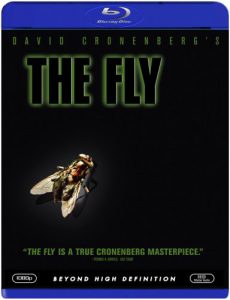
“The Fly” (1986) is writer-director David Cronenberg’s most mainstream piece of body horror, but that’s a contradiction because body horror will never be a mainstream genre. It’s always fascinating when a film like this creeps toward being widely viewed by normies – see also 2024’s “The Substance” – because invariably it will leave people emotionally scarred, even though objectively there are more grotesque movies out there.
But not a lot more grotesque. As a fan of “Star Wars” (happy sci-fi, if you will) born in 1978, I eventually tiptoed into grim sci-fi with the usual suspects such as “Alien” and “The Thing.” But for a total reverse of “Star Wars”-ian fairy tale principles, you have to go with “The Fly.” The monster design of “Alien” is elite, and the disgustingness of “The Thing” gets us closer to body horror, but in “The Fly” we see a human being (importantly, one we know and like) gradually fall apart.
It’s the opposite of a fairy tale, and it’s made more effective if a viewer thinks they’re going to see harmless wackadoo pseudo-SF. Maybe something in the cheesy tradition of 1950s monster movies, from which comes the original version, featuring (of course) Vincent Price.
“The Fly” (1986)
Director: David Cronenberg
Writers: Charles Edward Pogue, David Cronenberg (screenplay); George Langelaan (story)
Stars: Jeff Goldblum, Geena Davis, John Getz
Weird science isn’t so funny this time
Cronenberg’s remake starts with heady, hopeful science. Seth Brundle (Jeff Goldblum, in the role that put him on the SF map; look for early “pounding the table for emphasis” acting) is on the verge of revolutionizing transportation by essentially inventing “Star Trek’s” transporter. Two years earlier, “The Terminator” warned us against AI; we didn’t listen. “The Fly” warns us against teleportation. Luckily, instantaneous relocation of anything bigger than a particle is still the stuff of SF; see for example, “Fantastic Four: First Steps.”
It’s putting too much emphasis on a movie to say “The Fly” made scientists “afraid, very afraid” of pursuing teleportation. But Cronenberg’s message is clear: If you think an amazing science achievement seems too easy, it is.
Brundle’s initial teleporting of a baboon turns it inside out – and practical effects leader Chris Walas eases us into the grotesquery to come with this shot – but then (in what is arguably a continuation of “The Terminator’s” AI warnings), Brundle types abstract ideas about “the flesh” into his computer. To successfully teleport a baboon, the computer must know the ephemeral nature of a baboon, not just its particles and how they attach.

Brundle teleports a second baboon with success, but now the non-rational part of his brain – which allows him to communicate the essence of a baboon and to play the piano – will ironically be his undoing. Thinking girlfriend Ronnie (Geena Davis) has left him, he doesn’t take the time to do tests on the animal. Instead, he teleports himself, but a housefly joins him in the pod.
Co-written by Charles Edward Pogue (“Psycho III”) and coming from the 1957 short story by George Langelaan that also inspired the 1958 version, “The Fly” is the simplest of stories: Brundle gradually turns into a fly. There are layers, if you want to peel them back the way Brundle peels off skin, teeth and body parts: abortion, cancer and aging, in addition to reckless experimentation.
Displeasures of the flesh
And there’s great acting, part of why this is both the best and the most mainstream of Cronenberg’s catalog. Although Goldblum and Davis have enough of the same overbite to play siblings, their romantic chemistry is initially adorable. Because we like them, it then becomes tragic. The relationship wouldn’t be beyond salvaging except that Brundle is becoming more rickety than the cheap car Ronnie can afford as a freelance science journalist. As Goldblum commits to monster-suit acting, Davis turns on the emotion, and it’s devastating.
In my head, I remembered “The Fly” as a piece of fatalistic fiction, but – with brilliant cruelty – Cronenberg peppers in some hope that might fake out naïve viewers. For a while, it seems Brundle will become superhuman. Then it seems he’ll at least survive, albeit as a mutant fly. Perhaps he can change himself back by fusing with a human; the seeds of 2025’s “Together” can be found here.
As good as the acting and directing are, the one Oscar win is the correct one: best makeup (the closest the Academy could get to best practical effects). The work by the team of Walas (who would go on to direct “The Fly II” in 1989) is incredibly effective and stuck in its time as firmly as Brundlefly sticks to a wall.
In this case, “stuck in its time” is a compliment. “The Fly” sits at the heart of the golden age of practical effects, and although the art form is not dead – see subtle transformative work like in TV’s “Chad Powers” – it’s obvious from every mutant-insect shot that they don’t make ’em like this anymore.
I hope “The Fly” can still lure non-genre fans into its trap. Come for the cute love story, the wacky science and star-making turns by Goldblum and Davis; stay to be scarred for life by your introduction to body horror.
%20is%20a%20classic%20fairy%20tale%20…%20in%20reverse%20and%20inside%20out)
Leave a Comment