I need a hug after Whedon abuse allegations
TV commentary: It seems like a good time to further appreciate the folks other than Joss Whedon who made his shows great.
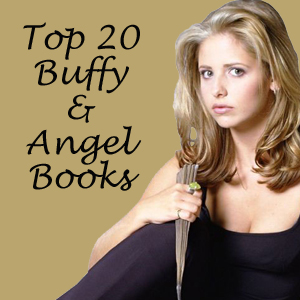
The top 20 ‘Buffy the Vampire Slayer’ and ‘Angel’ books
Book list: John picks the 20 elite “Buffy the Vampire Slayer” and “Angel” novels out of the nearly 100 spinoff books published since 1997.
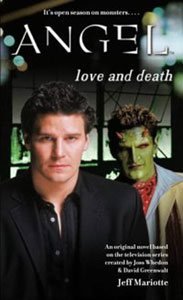
‘Angel’ flashback: ‘Love and Death’ (2004) (Book review)
Jeff Mariotte probably didn’t know “Love and Death” (October 2004) would be the last “Angel” novel when he wrote it, but it plays pretty well since it has that status. By Season 4, when this book is set, the likelihood that the general public doesn’t know about vampires and demons was starting to be stretched
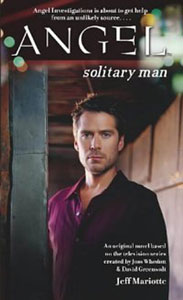
‘Angel’ flashback: ‘Solitary Man’ (2003) (Book review)
As he did with his love letter to hardboiled fiction, “Hollywood Noir,” Jeff Mariotte lets his passion for bloodless British mysteries show in “Solitary Man” (December 2003) – but in a different way. He invents Mildred Finster, a woman in the mold of Agatha Christie’s Miss Marple or “Murder, She Wrote’s” Jessica Fletcher – at
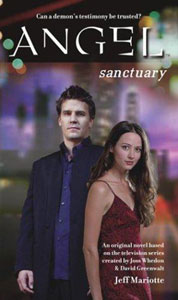
‘Angel’ flashback: ‘Sanctuary’ (2003) (Book review)
Jeff Mariotte recaptures some of the hardboiled style from “Hollywood Noir” in “Sanctuary” (April 2003), which has a straightforward mystery that all takes place in one night. It’s also an excellent character piece for Fred – marking one of her rare early ventures outside the Hyperion Hotel – even though she spends most of the
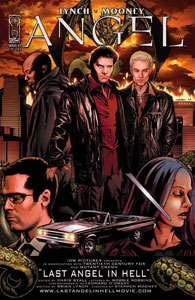
‘Angel’ flashback: ‘Last Angel in Hell’ (2009), ‘Lorne’ (2010) and ‘Yearbook’ (2011) (Comic book reviews)
IDW produced three “Angel” one-shots in the final three years of its run. All of these double-length issues are finales of sorts, and there’s a touch of comedy or lightness to them – “Last Angel in Hell” puts a bow on the “After the Fall” era, “Lorne: Music of the Spheres” is the final Lorne
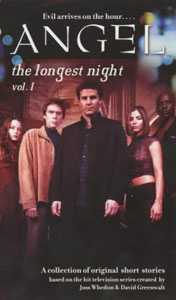
‘Angel’ flashback: All 12 short stories from ‘The Longest Night’ (2002), ranked (Book review)
It’d be cool to read an “Angel” book of 12 short stories that each take place in one hour on the longest night of the year. “The Longest Night” (December 2002), unfortunately, isn’t that book. It claims to be that book on the back cover blurb, but the editors never told the writers. So the gang
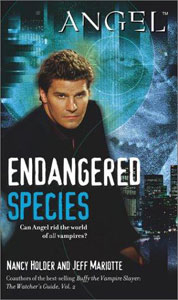
‘Angel’ flashback: ‘Endangered Species’ (2002) (Book review)
In the first “Angel” hardcover, “Endangered Species” (October 2002), Nancy Holder and Jeff Mariotte spend the first two acts delivering a decompressed narrative that shows their strong grasp of where the characters are at in early Season 3. We soak up Angel’s growing feelings for Cordelia and Fred’s post-Pylea introversion, and everyone is on their
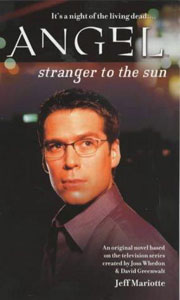
‘Angel’ flashback: ‘Stranger to the Sun’ (2002) (Book review)
You can rarely go wrong with a Jeff Mariotte Buffyverse novel, but some go more right than others, and “Stranger to the Sun” (July 2002) isn’t one of his elite efforts. His second book set in “Angel’s” second season is quite readable, but it’s pretty obvious where every plot thread is going right from the
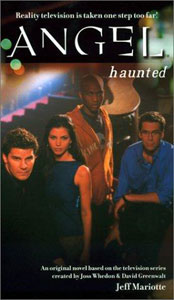
‘Angel’ flashback: ‘Haunted’ (2002) (Book review)
In my first reading of the “Angel” novel “Haunted” (February 2002), I probably wasn’t thrilled with the reality-TV focus. That was the era when a lot of good shows were being canceled to make room for cheaper and more profitable reality TV. Such fears seem silly today when there are more good scripted shows than